
Wireless Digital Microscope
4.2Editor score
WiFi and USB connectivity
Adjustable LED lighting
Portable handheld design
Documenting scientific observations has never been easier with the latest generation of digital microscopy tools. These devices allow researchers, hobbyists, and educators to capture high-resolution images and video of tiny specimens instantly. Choosing the right camera system ensures your data is accurate, shareable, and stored securely for future analysis.
We have evaluated ten distinct models based on resolution, connectivity options, ease of use, and overall value for money. Our analysis covers handheld units, stand-mounted systems, and specialized coin microscopes designed for specific inspection tasks. Each product offers unique features that cater to different users ranging from students to professionals.
Each selection below highlights key specifications and practical benefits to help you make an informed decision. Please note that prices and availability fluctuate regularly so we recommend verifying current details before purchasing. This list serves as a comprehensive starting point for your search for the perfect documenting solution.
4.2Editor score

4.4Editor score

4.6Editor score
As an Amazon Associate we earn from qualifying purchases.
The following table provides a side-by-side comparison of all ten products reviewed in this guide. It highlights key specifications and capabilities to help you quickly identify which model aligns best with your documentation requirements and budget constraints.



The Wireless Digital Microscope stands out as an accessible entry point for those needing basic sample documentation without a large investment. It features a versatile connection method allowing use with smartphones or computers via WiFi or USB cables. The included LED lighting ensures adequate illumination for most standard inspection tasks.
We may earn a commission when you buy through this link, at no additional cost to you.
Its primary strength lies in simplicity and portability making it ideal for fieldwork or quick classroom demonstrations. Users can instantly capture photos or videos using the dedicated button on the device or through the companion app. This eliminates the need for complex setups often required by traditional optical systems.
Trade-offs include a fixed focal length which may require precise positioning to achieve sharp images. The software experience can vary depending on the operating system version so keeping apps updated is crucial. It is not intended for high precision biological research but serves well for general inspection.
Buyers looking for a cost effective tool to document coins circuit boards or plant specimens will find this model highly practical. Its ease of use makes it suitable for students and hobbyists who prioritize convenience over laboratory grade precision. It remains a solid choice for casual users seeking immediate visual results.
The ability to switch between WiFi for mobile use and USB for computer tethering offers significant versatility for different workflows.
Eight adjustable LED lights provide customizable brightness levels to reduce glare and enhance detail visibility on various surfaces.
We may earn a commission when you buy through this link, at no additional cost to you.
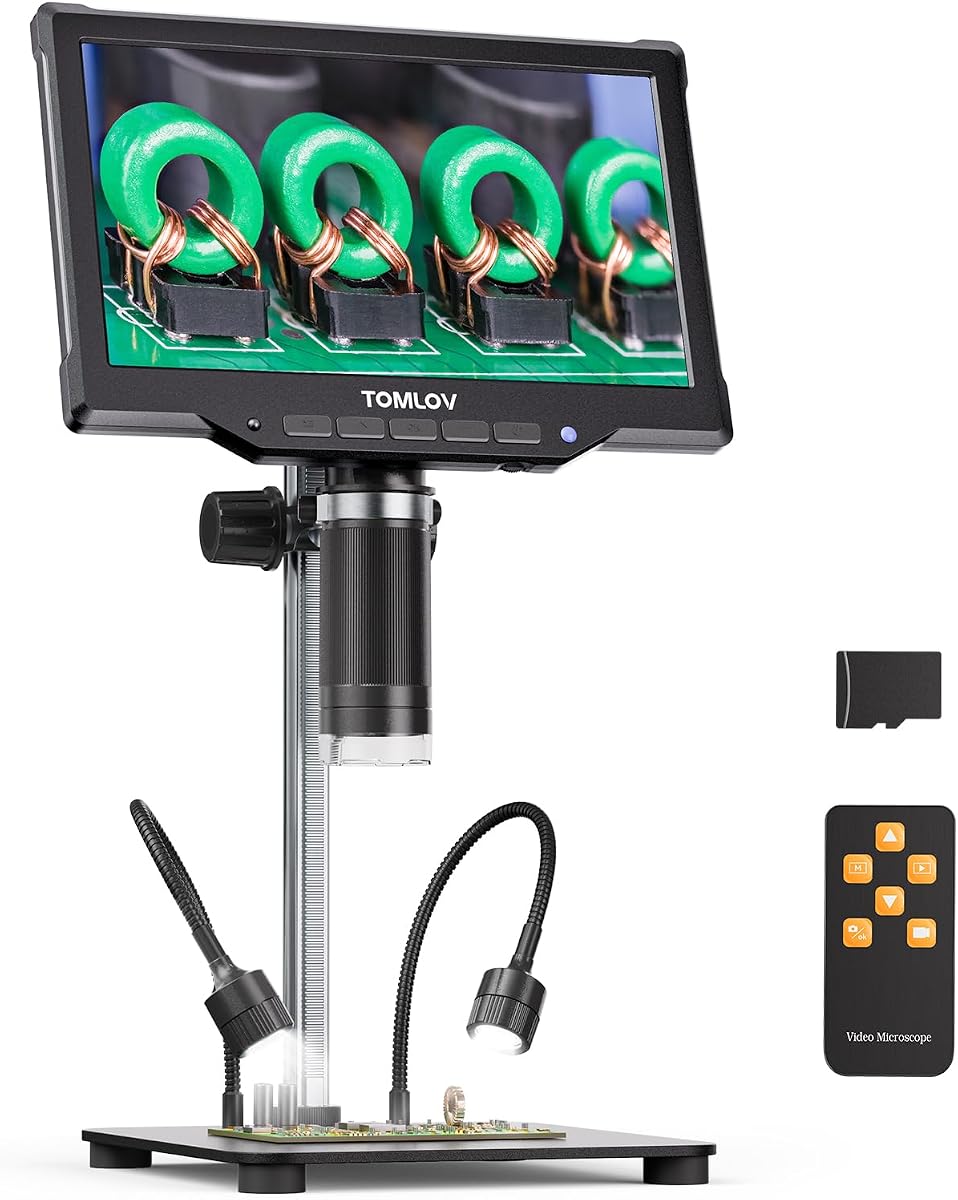
The TOMLOV DM9 is engineered specifically for detailed examination of coins small electronics and collectibles. Its built-in 7 inch screen allows users to view specimens directly without needing an external monitor or device. The high magnification capabilities reveal fine details like mint marks and solder joints with clarity.
We may earn a commission when you buy through this link, at no additional cost to you.
This model excels in stability thanks to its solid metal base and adjustable stand which minimize hand shake during prolonged observation. The inclusion of a 16GB memory card ensures you can store numerous high resolution images locally without worrying about storage space. It also connects to PCs for larger viewing when needed.
While effective for hobbyists it may lack the versatility of a compound microscope for biological samples. The focus mechanism is manual requiring careful adjustment to maintain sharpness across different distances. However for its intended purpose of inspecting small mechanical or numismatic items it performs exceptionally well.
Collectors and DIY electronics enthusiasts will appreciate the balance of features and usability offered by this device. It provides a dedicated environment for analyzing small parts without the complexity of traditional optical microscopes. The clear visuals and robust build make it a reliable tool for documenting condition and details.
The large integrated screen removes the need for external displays allowing immediate feedback during inspection tasks and collaborative review sessions.
Pre-installed memory means you can start capturing images right away without purchasing additional accessories or setting up cloud services.
We may earn a commission when you buy through this link, at no additional cost to you.
The Elikliv EM4K-AF represents a significant leap in digital microscopy with its automatic focus technology. It uses a Time of Flight sensor to continuously adjust focus ensuring sharp images even when objects move slightly. This feature is particularly valuable for dynamic inspections or when working with uneven surfaces.
We may earn a commission when you buy through this link, at no additional cost to you.
Video quality is exceptional with true 4K resolution providing unprecedented detail for documentation purposes. The 8 inch IPS display offers vibrant colors and wide viewing angles which enhances the user experience during extended sessions. Additional features like split screen allow for side by side comparison of different sample areas.
While the cost is higher than entry level models the efficiency gains from the auto focus system justify the investment for many users. The battery enables cordless operation which is useful for field inspections where power outlets are unavailable. However battery life may vary depending on usage intensity and brightness settings.
Professionals in electronics repair or quality control will benefit most from the precision and speed this unit offers. It bridges the gap between portable handheld devices and stationary lab equipment by combining high resolution with mobility. This makes it a top choice for those requiring reliable and fast sample analysis.
The AI driven focusing system eliminates manual adjustments saving time and ensuring consistent image quality across various sample types.
High resolution recording captures minute details that might otherwise be missed aiding in accurate diagnosis and comprehensive documentation.
We may earn a commission when you buy through this link, at no additional cost to you.
The TOMLOV DM10 focuses on providing a large viewing area with its 10.1 inch IPS display making it easy to share findings with others. This size is beneficial for classroom settings or team reviews where multiple people need to see the specimen clearly. The magnification range supports detailed work on coins and small components.
We may earn a commission when you buy through this link, at no additional cost to you.
Included wireless remote control allows users to capture images without touching the device reducing vibration and ensuring sharper photos. The lighting system combines ring LEDs with gooseneck lights to eliminate shadows and provide uniform illumination. This combination enhances the visibility of textures and fine details on any surface.
Portability is somewhat compromised due to the large screen and stand size but it remains manageable for transport. The unit requires careful handling to avoid screen damage during movement. For stationary or semi stationary use however it offers one of the best viewing experiences in its class.
Educators and collectors will find the large screen particularly useful for presentations and group analysis. It simplifies the process of examining small objects by making details visible to a wider audience. The ease of use combined with robust imaging capabilities makes it a strong contender for professional and educational environments.
The expansive screen allows groups to examine specimens together facilitating collaborative learning and discussion without needing individual devices.
Using a remote minimizes physical contact with the microscope preventing sample displacement and ensuring stable image capture every time.
We may earn a commission when you buy through this link, at no additional cost to you.
This Swift camera is designed to attach directly to the eyepiece tube of existing optical microscopes transforming them into digital systems. It offers a practical upgrade path for labs or schools that already own quality optics but lack digital capture capabilities. The Sony sensor ensures high sensitivity and good image quality even in lower light conditions.
We may earn a commission when you buy through this link, at no additional cost to you.
Performance is marked by a smooth live view rate of up to 30 frames per second allowing for real time observation. This speed is sufficient for tracking moving specimens or adjusting focus dynamically during use. The software supports multiple operating systems making it accessible across different institutional IT environments.
Compatibility is broad fitting 23.2mm 30mm and 30.5mm tubes with included adapters. However the reliance on USB 2.0 means transfer speeds are slower compared to modern USB 3 standards. Additionally setup requires a working optical microscope so it is not a standalone solution for new buyers.
Existing microscope owners looking to digitize their workflow will find this a cost effective solution. It preserves the investment in high quality lenses while adding modern documentation features. Its reliability and ease of integration make it a sensible choice for educational institutions and small research labs.
Designed to work with standard eyepieces this camera leverages existing optical investments rather than replacing the entire microscope setup.
High frame rates ensure that moving samples can be observed in real time without lag or stuttering during critical adjustments.
We may earn a commission when you buy through this link, at no additional cost to you.
The Andonstar AD246S-M distinguishes itself with three interchangeable lenses tailored for different tasks like soldering coin inspection and biological slides. This versatility makes it a comprehensive kit for users with varied interests requiring different magnification ranges. The HDMI output supports large monitor display which is excellent for presentations.
We may earn a commission when you buy through this link, at no additional cost to you.
Included accessories such as slides and tweezers provide a complete package ready for immediate use. The measurement software allows for precise dimensional analysis adding a professional layer of utility to the device. A robust boom arm stand ensures stability and flexibility in positioning the camera head accurately.
While the multi lens approach adds value it also introduces complexity in terms of setup and maintenance. Users must carefully manage lens changes to avoid misalignment or damage. It is a powerful tool for serious hobbyists or small workshops that need to handle diverse inspection types regularly.
Those who value flexibility and professional features will appreciate the comprehensive nature of this kit. It supports a wide range of applications from electronics repair to biological study with equal effectiveness. The inclusion of measurement tools further enhances its utility for quality control and technical documentation.
Swappable lenses allow one unit to cover soldering coin inspection and biological needs reducing the need for multiple specialized devices.
Built-in software tools enable precise measurements and calculations directly from the microscope interface streamlining technical workflows.
We may earn a commission when you buy through this link, at no additional cost to you.
This model blends traditional binocular optical viewing with a digital USB camera attachment for documentation. It offers the classic microscope experience preferred by many scientists and students while enabling image capture. The dual light source provides flexible illumination options for various specimen types and conditions.
We may earn a commission when you buy through this link, at no additional cost to you.
Optical quality is a strong point with achromatic objectives reducing color aberration and improving clarity. The fine focus knobs allow for precise control which is essential for high magnification work. This makes it suitable for detailed biological or material science investigations requiring sharp and consistent images.
The digital component is an addition rather than a replacement meaning users still rely on the eyepieces for primary viewing. This hybrid approach can be slightly cumbersome but offers the best of both worlds. Proper setup is required to align the camera correctly with the optical path.
Ideal for schools or home labs where both hands on viewing and digital recording are needed. It supports a more rigorous study approach than simple handheld magnifiers. The inclusion of a camera ensures that observations can be shared and archived effectively without sacrificing optical performance.
High quality objectives provide clear true color imaging which is critical for accurate scientific observation and analysis.
The ability to view through eyepieces and capture digitally simultaneously offers unique flexibility for teaching and learning environments.
We may earn a commission when you buy through this link, at no additional cost to you.
The SWIFT SW320T is a robust trinocular microscope designed for serious users requiring high magnification capabilities. Its head allows simultaneous viewing through eyepieces and connection to a digital camera for documentation. The mechanical stage ensures precise specimen movement which is vital for systematic examination.
We may earn a commission when you buy through this link, at no additional cost to you.
With a maximum magnification of 5000X using the Barlow lens it reaches levels suitable for detailed cellular study. The ergonomically tilted head reduces strain during long sessions making it comfortable for extended use. A sturdy carrying case makes transport easier though the unit itself is substantial in size.
The included 2MP camera serves basic documentation needs but may not match the resolution of dedicated external units. Users seeking higher image fidelity might consider upgrading the camera later. The optical path is optimized for clarity and light efficiency providing sharp and bright images.
Educational institutions and advanced hobbyists will find this model highly capable for varied research tasks. It balances traditional optical excellence with digital integration needs effectively. The comprehensive kit ensures all necessary tools are present to start detailed microscopic work immediately.
The adjustable head angle reduces physical strain allowing researchers to maintain comfort during extended periods of observation.
Up to 5000X zoom enables detailed study of cellular structures and fine material properties not visible to the naked eye.
We may earn a commission when you buy through this link, at no additional cost to you.
This trinocular microscope is built for research grade applications requiring high stability and precision. It features a double layer mechanical stage that allows accurate positioning of specimens for systematic analysis. The USB camera enables easy image capture and sharing for reports or remote collaboration.
We may earn a commission when you buy through this link, at no additional cost to you.
Optical performance is optimized with high NA objectives and a variable diaphragm for controlling light and contrast. This ensures that even minute details are visible and well defined during inspection. The 5000X magnification range supports deep study of cellular and micro structural elements.
While highly capable it requires a steady hand and proper training to use effectively. The mechanical stage and focus knobs offer precision but demand practice to master. It is not a toy but a serious tool for scientific and technical documentation.
Professionals and serious students in biology or materials science will benefit most from its reliability. It provides the depth of control needed for accurate data collection and long term study. Its robust construction ensures longevity even under regular and demanding usage conditions.
The double layer stage enables precise coordinate movement which is essential for detailed mapping and consistent sample analysis.
High quality optics and light control tools deliver superior contrast and detail for professional grade research documentation.
We may earn a commission when you buy through this link, at no additional cost to you.
The Swiftcam 25 Megapixel Camera delivers exceptional resolution for those needing detailed still images from a microscope. Its USB 3.0 connection ensures fast data transfer which is vital for handling large high res files efficiently. The included reduction lens maintains the correct field of view for accurate documentation.
We may earn a commission when you buy through this link, at no additional cost to you.
Compatibility across Windows Mac and Linux systems makes it versatile for diverse IT environments. The calibration kit helps ensure measurements and images are accurate and reliable over time. This makes it a powerful addition for labs that prioritize high fidelity imaging and precise data.
Cost is a factor as this camera is priced significantly higher than standard models. It requires an existing trinocular port or compatible eyepiece to function. Users must have a quality optical system to fully leverage the sensor's capabilities.
Advanced users and institutions seeking top tier digital documentation will find the resolution worthwhile. It captures minute details that lower resolution sensors might miss. The comprehensive accessory package ensures it is ready to integrate into any modern microscope setup effectively.
USB 3.0 transfer speeds allow for rapid saving and processing of high resolution images improving overall workflow efficiency.
The reduction lens ensures the camera sees exactly what the eye sees through the eyepiece preventing optical distortion errors.
We may earn a commission when you buy through this link, at no additional cost to you.
Selecting the right camera depends on your specific sample types and how you intend to store or share data.
Resolution determines how much detail you can capture in each image. For general inspection 2MP to 5MP is sufficient but for scientific documentation higher resolution like 12MP or 25MP ensures fine textures are preserved. Look for sensors that support high frame rates if you need to capture moving samples.
Prioritize resolution based on whether you need broad overviews or minute detail analysis for your specific projects.
Modern cameras offer WiFi USB or HDMI connections. WiFi provides flexibility for mobile use while USB offers stability and direct computer access. HDMI allows connection to external monitors which is useful for presentations or sharing views with a team. Consider where you will primarily be using the device.
Choose a connectivity method that matches your workflow and available ports on your devices.
Different tasks require different levels of magnification. Handheld units often range from 50X to 1000X while compound models can reach 5000X or more. Ensure the range covers your needs whether it is viewing coin details or biological cells. Adjustable focus is essential to maintain clarity across these ranges.
Verify the effective magnification range supports the size of specimens you plan to document regularly.
Proper lighting is critical for clear images. Look for adjustable LEDs or dual light sources that allow you to reduce glare and shadows. Some models include flexible gooseneck lights for directional illumination. Good lighting enhances contrast and reveals textures that might otherwise remain hidden.
Select a unit with versatile lighting options to ensure consistent visibility across different sample surfaces.
Internal storage or memory card support is necessary for saving photos and videos. Some devices include cards while others require your own. For large projects ensure the storage capacity is sufficient to hold high res files without constant transfers. Cloud integration may also be an option for sharing.
Check storage limits and compatibility to avoid losing data during critical documentation tasks.
If you need to move the device often a lightweight handheld design is preferable. Fixed stand models offer stability for detailed work but are harder to transport. Consider the physical size and weight in relation to your work environment. A carrying case adds protection if frequent travel is expected.
Match the physical design to your workspace constraints and mobility requirements.
The software must support your operating system whether it is Windows Mac or Linux. Some manufacturers offer specialized tools for measurement and analysis which adds value. Ensure drivers are available and easily installed. Compatibility issues can hinder productivity if the software does not work with your devices.
Verify software availability and features to ensure a smooth setup and usage experience.
Prices vary widely from under fifty dollars to several hundred. Determine your budget and balance it against necessary features. Basic models suit casual hobbyists while professional needs justify higher costs. Look for packages that include essential accessories to avoid extra purchases later.
Invest in a model that provides the best return on investment for your specific use case.
Start by securing your sample on a flat surface to ensure stability during imaging. Adjust the lighting until glare is minimized and details are clearly visible. This foundational step prevents blurry images caused by movement or poor illumination.
Use the capture button or software interface to take photos or record videos. Keep the device steady using a stand or tripod if necessary. For digital units ensure the focus is sharp by adjusting the distance between lens and sample carefully.
After use clean the lens with a soft cloth to avoid scratching. Store the unit in a dry place away from direct sunlight to protect electronics. Regularly update software to maintain performance and compatibility with your devices.
Most models are designed for indoor use where lighting can be controlled. Some handheld options work outdoors but require good natural light and careful handling to avoid glare. Check battery and weather resistance if planning outdoor fieldwork.
Most digital microscopes save images and videos to SD cards or internal memory. Common formats include JPEG for photos and MP4 or MOV for videos. These are standard formats easily opened on computers and shared online without conversion.
Handheld and coin scopes can view small insects or plant parts but may struggle with living cells in water. Compound models with slide holders are better for biology. Ensure the focus range allows for thin slides if studying cells.
Many models create a WiFi hotspot you connect to via your phone's settings. Download the companion app from the App Store or Google Play. Some require USB OTG cables for direct connection depending on the device.
Most require software to unlock features like measurement and saving files. Some operate as standard webcams without extra install. Check product details for plug and play support if you want simple setup.
With proper care these devices can last several years. Electronics may degrade faster in humid environments. Keep lenses clean and avoid dropping the unit. Manufacturer warranties usually cover defects for one year.
Yes most models support video recording to capture movement or assembly processes. Resolution varies by model so check specs before buying. Videos can be saved to SD cards or directly to your computer.
Stability is key for clear images especially at high magnification. Handheld units work best with a steady hand or a stand. Tripods or fixed bases reduce shake and improve overall quality of your captures.
We have reviewed ten diverse options ranging from budget handheld units to professional research systems. Each model offers unique strengths suited for different tasks whether you are inspecting coins studying biology or documenting repairs.
Prioritize features like resolution and connectivity that align with your specific documentation goals. A device that excels in one area may lack in another so balance your needs carefully against the available options.
Prices and availability can change frequently so always check current listings before purchasing. This guide aims to simplify your decision by highlighting the most practical features for effective sample documentation in 2026.